
When to See a Doctor About Sleep Problems (and What to Ask)
There is no shortage of things you could try for sleep. The harder question is which next step makes sense for the person having the problem.
Here is a practical way to organize that conversation with a doctor. If you feel you have tried everything already, that article is a good place to start too.
Start with the part that affects your life
Describe the main type of sleep problem and why it matters: "I keep waking and then struggle to concentrate during client meetings." That gives the conversation a purpose beyond improving a number on an app.
Mention when it began and what was happening around that time. The history helps decide which questions deserve attention.
Look for details that change the priority
Consider three different accounts:
- "The room is noisy and my schedule varies." The practical sleep setting and available sleep time need attention.
- "The waking began with night sweats." That raises a question about related symptoms and possible contributors, including life-stage changes like menopause. Night sweats have several possible causes.
- "My partner has noticed breathing pauses." That calls for a doctor's evaluation for a possible sleep-related breathing disorder; buying another sleep product should not come first.
These examples don't diagnose anyone. They show why the same phrase, "poor sleep," can lead to different next steps.
Use the wider picture selectively
Related symptoms, existing conditions, medicines, daily habits, and available records may change the discussion. A broad review should still lead to a focused decision. Having a framework doesn't mean every category needs testing or treatment.
For example, night sweats can open a hormone-related question without proving a hormone problem. A previous lab result becomes useful when someone explains which question it helps answer and whether it is still relevant.
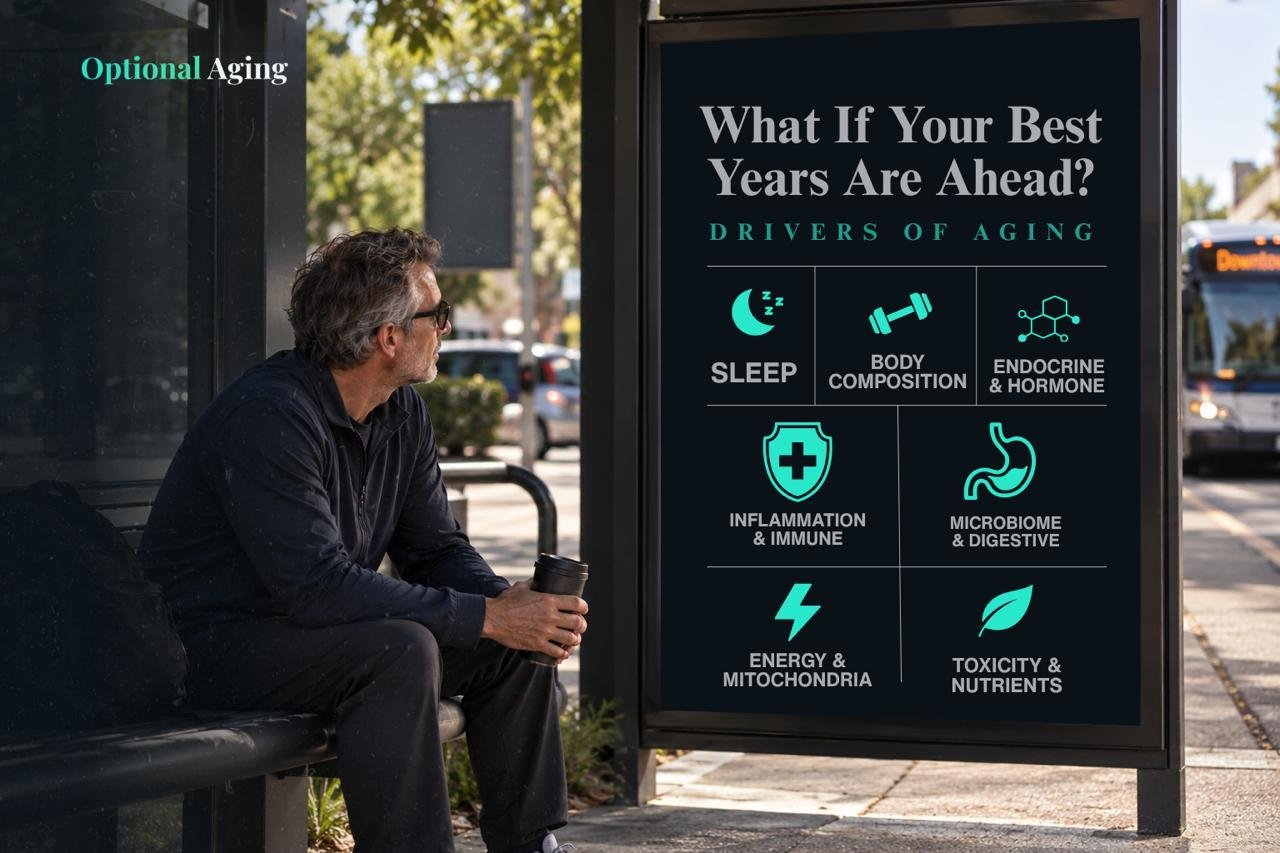
Where the Seven Drivers fit
Optional Aging uses these seven categories to organize information:
- Sleep Dysfunction
- Body Composition & Metabolic Dysfunction
- Endocrine & Hormone Dysfunction
- Inflammation & Immune Dysfunction
- Energy & Mitochondrial Dysfunction
- Digestion & Microbiome Dysfunction
- Toxicity & Micronutrient Imbalance
The formal names describe areas in the Optional Aging framework. They don't mean you have each condition. Nutrition, activity, and mindset/stress are supporting foundations.
For a sleep concern, we start with sleep and bring in other areas when your history gives us a reason. Questionnaire scores can organize a discussion; they can't tell us why a symptom is happening.
Your takeaway and next step
Your takeaway: A useful review connects your history to a focused next step and explains why that step deserves attention.
Your next step: Choose one unanswered question you want to bring to your next healthcare conversation and save it in your notes. For example: "My awakenings started around the same time as another change. What should we look at first, and why?"
Want to keep learning?
For more education and discussion about sleep, energy, and healthy aging, you're welcome in the free Optional Aging community on Skool. Join the free community
Not sure where to start? Take the free DriversPulse assessment to see which areas may be affecting how you feel. It's free, with no cost to you. Take the free DriversPulse assessment
Want a doctor to look at the whole picture? With Healthspan Radar, Dr. Sajad Zalzala personally reviews your health story and any labs you choose to share. Get my Healthspan Radar
Educational information only. This article does not diagnose any condition or replace care from your own doctor.
Written by Dr. Sajad Zalzala, physician and founder of Optional Aging.